Showing posts with label israel. Show all posts

Wednesday, November 13, 2013

EVENT: The Soldier and the Refusnik

Inline image 1
The Soldier and the Refusenik
Harvard Hall 201
Wednesday, November 13th, 6-7:30

Come hear Eran Efrati, a former IDF soldier, and Maya Wind, an Israeli activist imprisoned for her conscientious objection to military service, as they share their thoughts and personal experiences on the Israeli-Palestinian Conflict. Visit their website at http://www.soldierandrefusenik.com/ for more details. 

Sponsored by the Palestine Solidarity Committee, Progressive Jewish Alliance, Harvard Law School Justice for Palestine and Harvard Divinity School Connect with Palestine

Monday, November 11, 2013

EVENT: Open Conversation on Israel with Avraham Burg

An Open Conversation on Israel with Avraham Burg
Monday, November 11
6:30-8pm Quincy House JCR 

talk and Q&A with former Speaker of the Israeli Knesset and author of The Holocaust is Over

Inline image 1

This conversation will happen just a day before Burg gives the Samuel L. and Elizabeth Jodidi Lecture at the Weatherhead Center, entitled "Israel and Palestine: From Iconic Conflict to Iconic Solution or, Is It Time for New Paradigms?"

Avraham Burg is an Israeli author, social activist, former politician, and a leading voice for peace in the Middle East. He was an adviser to Prime Minister Shimon Peres on diaspora affairs; speaker for the Israeli Knesset from 1999 to 2003; chairman of the Jewish Agency for Israel; cofounder of Molad, a progressive think-tank dedicated to the advancement of Israeli democracy; chairman of Mifalot, a sport -for-peace project; an international coordinator of the Bruno Kreisky Forum for International Dialogue in Vienna; and a teacher at the Diplomatic Academy of Vienna.

His bestselling book, The Holocaust is Over; We Must Rise from Its Ashes, delineates a path for the Jewish people to come to live in greater peace and security in the Middle East and in the world. Hosted by: Progressive Jewish Alliance, Palestine Solidarity Committee, Harvard Students for Israel, and J Street U Harvard

Tuesday, October 22, 2013

EVENT: Advancing Peace through Environmental Research

Nature Knows No Borders: Advancing Peace through Environmental Research in the Middle East

Come hear graduate student Leila Hashweh share her experiences as a Palestinian environmentalist working for water restoration in Israel-Palestine


Sunday, October 27th
7:00-8:30pm
Hillel

Cosponsored by Harvard’s Progressive Jewish Alliance, J Street U Harvard, the Arava Institute for Environmental Studies, and The New Israel Fund

Friday, March 22, 2013

Criticism of Israel is Not Anti-Semitic

Over the past week, a dangerous rumor has circulated accusing the Harvard College Palestine Solidarity Committee (PSC) of targeting Jewish students in its campaign to raise awareness about the demolition of Palestinian homes. We, the Harvard College Progressive Jewish Alliance, strongly refute these lies and affirm that Jewish students were not targeted. While we do not endorse PSC’s campaign, we support their right to draw attention to problematic Israeli policies and believe that flyering is a legitimate and reasonable way to do so.


As part of Harvard Israeli Apartheid Week, PSC flyered student dorms with mock eviction notices in order to raise awareness about the demolition of Palestinian homes in the Occupied Territories. Such flyering is a common means of advertising and campaigning utilized by a wide variety of student organizations. PSC placed these notices on all suite doors in any given dormitory. However, in response to these flyers, several publications began circulating the falsehood that PSC specifically targeted Jewish students in its campaign. This claim is completely wrong, and it is clear to students who live in the dorms that Jewish students were not targeted.


Moreover, several publications have accused PSC of employing anti-Semitic rhetoric in its campaign. These claims are baseless; as PSC
affirms in a public statement on its website, these accusations “conflate [PSC’s] criticism of Israeli human rights violations with hatred of the Jewish people.” Indeed, in its mission, PSC “condemn[s] any hatred or discrimination against any racial, ethnic, or religious group." Anti-Semitism is a serious problem, and these claims minimize the seriousness of real anti-Semitism as well slander and harm the falsely accused. 


We condemn all organizations and publications both within and outside Harvard that continue to spread lies about PSC, and we ask them to immediately publish corrections stating that PSC did not target Jewish students or engage in other anti-Semitic behavior. In light of the anti-Semitic and racist incidents at Oberlin College over the past month, we hope that individuals and organizations devoted to fighting anti-Semitism will not diminish the significance of true anti-Semitism by branding criticism of Israeli policies as anti-Semitic.

Saturday, February 9, 2013

EVENT: Israeli Democracy after the Elections with the NIF


The Progressive Jewish Alliance is excited to co-sponsor a discussion on "The Left, the Right, and the Center: Israeli Democracy after the Elections" with the New Israel Fund, an organization promoting social justice in Israel. This event will be held on Sunday at 7pm in Beren Hall (2nd floor of Hillel), and you can RSVP here. We hope to see you there!


The Left, the Right, and the Center:
Israeli Democracy after the Elections
A discussion with Dr. Sara Hirschhorn
Please join us for learning, schmoozing and conversation as Dr. Sara Hirschhorn leads us through an overview of the political scene in Israel.  Who are Israel's left wing and right wing, and what do they want?  What is their understanding of religion, democracy and the rule of law in Israel?  What do the results of Israel’s recent election tell us about the priorities of Israel's citizens, and what do they suggest about the future?
Sunday, February 10, 2012
7:00 - 8:30 pm
Doors open at 6:45, program to begin by 7:05
Harvard Hillel, Beren Hall
Dr. Sara Hirschhorn was born and raised in Western Massachusetts while spending considerable amounts of time in Israel throughout her childhood.  She graduated with honors from Yale University and received her M.A. in Middle East Studies from the University of Chicago.  Sara recently earned her doctorate in History at the University of Chicago, where she wrote her dissertation entitled “City on a Hilltop: The participation of Jewish-American Immigrants within the Israeli Settler Movement, 1967-1987.”  Sara is currently a postdoctoral fellowship at the Schusterman Center for Israel Studies at Brandeis University, where her research focuses on the Israeli ultra-nationalist movement, the Arab-Israeli conflict, and the relationship between the U.S./American Jewry and Israel.  She is also a regular op-ed contributor to HaaretzThe Times of Israel, and the Israeli conflict resolution webzine Efshar Lahshov (CanThink).
New Israel Fund: New Generations is an open and vibrant community of young professionals, social activists, community leaders, and others in their 20s and 30s who are committed to the work of the New Israel Fund, the leading organization promoting social justice and equality for all Israelis. New Gen provides an opportunity to learn about and engage with the most important issues facing Israel today through lectures, group discussions, and social events.

Thursday, November 15, 2012

Op-Ed from the Crimson: An Open Hillel

Check out PJA's recent op-ed in the Harvard Crimson!
------------------------------------------------------------------------------------------------

An Open Hillel

Monday, November 12, 2012

An Open Letter to the Hillel Community

The following letter, written by the members of PJA, has been sent out over various Hillel community listservs in response to the recent events at Hillel (outlined in the Crimson article posted below).

------------------------------------------------------------------------------------------

Dear Hillel Community,

We, the Progressive Jewish Alliance (PJA), are writing to inform you of something deeply troubling that happened recently. Several weeks ago, PJAa Hillel affiliated groupbegan working with the Harvard College Palestine Solidarity Committee (PSC) to plan a speaker event, “Jewish Voices Against the Israeli Occupation.” As two campus organizations that both work for peace and justice in Israel and Palestine, PJA and PSC often co-sponsor events. We planned to bring an Israeli Jew and an American Jew to talk about their work doing non-violent activism against the Israeli occupation, such as peaceful protests against the demolition of Palestinian homes. The speakers would also discuss how Jewish students going on Birthright could extend their stays in order to visit the West Bank in addition to Israel on their trip. Since this event is explicitly Jewish in nature and directed mainly at Jewish students, we believed that Hillel would be the ideal location for the event.

Initially, Jonah Steinberg (Hillel’s executive director) approved this event and told us that we could hold it in the Hillel building. We believed, after this first conversation, that Jonah had understood that PJA and PSC would be co-sponsoring the event, although we later learned that he had not. Once we put out advertisements for the event, Jonah began receiving complaints about this co-sponsorship, and he expressed uncertainty to us about whether this event could in fact be held in Hillel. Hillel International’s standards of partnership declare that “Hillel will not partner with, house, or host organizations, groups, or speakers that... support boycott of, divestment from, or sanctions [BDS] against the State of Israel,” which PSC does. After major donors threatened to withdraw their money from Harvard Hillel, Jonah informed us that the event could no longer take place in the Hillel building.

We are disturbed and saddened by this decision to remove our event from Hillel. As progressive Jews working for peace and justice in Israel/Palestine, we believe that collaboration with Palestinian groups is essential.  We see such cooperation as a step on the path to peace, and we are disappointed that even when Palestinian groups reach out to partner with us, their overtures are rejected by our Jewish community.

The BDS movement is the largest non-violent campaign protesting the injustices of the Israeli occupation. Although we may have disagreements with this movement, we believe it is essential to find common ground and collaborate where we can. Completely shutting out any groups that advocate for BDS cuts off a huge portion of the population that cares about Israel/Palestine, including almost every Palestinian student group across the country. Excluding these ideas from the Hillel building does not make them disappear, but serves only to prevent productive dialogue and alienate people from Hillel. Jewish people who care about peace must frame our disagreements respectfully, allowing for discussion and thoughtful exchange of ideas, instead of putting up barriers to cooperation with others who seek peace.

Hillel International’s policy also excludes some Jews and Jewish groups from Hillel. For example, the Brandeis chapter of Jewish Voice for Peace, which advocates for divestment from companies that profit from the Israeli occupation, was recently prevented from affiliating with Brandeis Hillel. We are disturbed to see progressive Jews excluded from Hillels for their political views. Although PJA is not currently in this situation, we feel less welcome and included in a community that sets a political litmus test to determine which Jewish students and groups will be allowed in. Such a community is not one that reflects our Jewish values of social justice and vigorous debate.

Within the Jewish community, boycott calls are becoming more mainstream. Peter Beinart, a well-known liberal Zionist who spoke at Harvard Hillel last spring, recently called for Jews who care about Israel to boycott the settlements as a protest against Israel’s continued expansion into Palestinian territory and the unequal treatment of Jews and Palestinians in the West Bank. Many progressive Jews agree with his position, yet Hillel International’s policies would exclude these voices from its Jewish community. If Hillel truly wants to be “the foundation for Jewish campus life,” it must represent and support all of the diverse views held by Jewish people.

Universities should promote open discussion, critical thinking, and debate, and Hillel should similarly uphold these valuesvalues essential to a democratic society. This, of course, does not mean that Hillel needs to provide space for the expression of racist, anti-Semitic, or otherwise hateful views. However, Hillel must not fall prey to the common fallacy that any criticism of Israel is anti-Semitic. BDS is not an irrational, hate-based ideologyrather, it is a political position that can, and should, be discussed and debated.

Finally, we strongly object to the idea that outside organizations and donors can step in to prevent student-initiated programming in Hillel whenever they disagree with it. Hillel is, and should be, a student-driven community, and students ought to play the primary role in determining its policies and programming. Jonah wrote that Hillel’s Israel policy should be determined by “students, Board of Directors members, and stakeholders.” We wonder who these “stakeholders” are, and why they are given influence over Hillel’s policies equal to that of students. If students’ programming can only go forth according to the whims of Hillel’s donors, Hillel will quickly cease to be a meaningful center for Jewish student life.

In response to these recent events, we conclude that Hillel should have no policy on the political affiliation of groups, organizations, and speakers that it partners with, houses, and hosts. We ask that Hillel International remove its guidelines for Standards of Partnership for campus Israel activities, which currently work to exclude groups and individuals with particular political views from campus Hillels. Regardless of the actions taken by Hillel International, we believe that Harvard Hillel should not establish policies that put in place a political test for its co-sponsorships or affiliated groups. Rather, we hope that Harvard Hillel will lead the push for more inclusive policies on a national level.

PJA and PSC will still be holding the “Jewish Voices Against the Occupation” eventnow in Emerson Hall 305 at 7:30pm this Thursday. We invite students from Hillel to attend and to talk to members of PSC, so that Hillel’s current restrictions will not stand in the way of dialogue between Jews and Palestinians on campus.

Most of all, we hope that a broad coalition of Hillel students of all political affiliations can come together in support of more open and inclusive policies. If you have any questions or concerns, members of PJA will be in the Hillel dining hall from 5-7 pm tonight, tomorrow, and Wednesday, and would be happy to talk to you. You can also contact Emily, the chair of PJA, at eunger@college.harvard.edu to bring up any thoughts or to find a time to talk about this in person.  

With hope for a more peaceful and inclusive future,
The Harvard College Progressive Jewish Alliance
Emily Unger
Rachel Sandalow-Ash
Sandra Korn
Eva Roben
Sasha Johnson-Freyd
Elena Hoffenberg
Joshua Blecher-Cohen
Ann Finkel
Virginia Marshall

Thursday, November 8, 2012

Jewish Voices Against the Occupation - now in Emerson!

EDIT: Jewish Voices Against the Occupation, the even we're co-hosting with Harvard PSC, is now taking place in Emerson Hall 305, not in Harvard Hillel's Rabb Hall. See the poster below!


Sunday, October 28, 2012

EVENT: Jewish Voices Against the Israeli Occupation

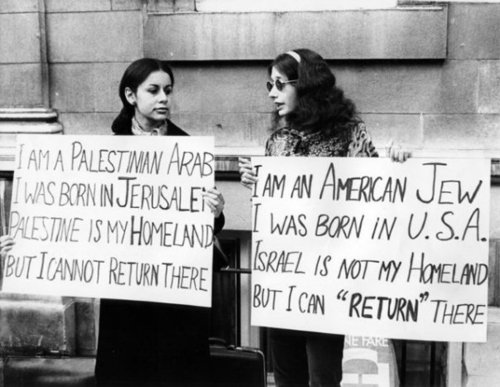
Taken in 1973 during a protest outside of the Israeli Embassy
Harvard Progressive Jewish Alliance and Palestine Solidarity Committee are proud to present “Jewish Voices Against the Israeli Occupation” Thursday, November 15 at 7:30 PM in Rabb Hall of Harvard Hillel.  

This event brings together two speakers, Jewish Israeli Noam Lekach and Jewish American Jeff Stein, to speak about the forms of peace activism work they have been engaged in across the Holy Land in the hopes of achieving a more just and more peaceful status quo for Jews and Palestinians. The speakers will reflect critically on the role their Jewish identities and upbringings have played in their activism and how it has informed their understanding of what a “just peace” looks like and how we get there.

They will also be discussing Birthright Israel and the ways Jewish Americans going on this trip can see more than just the mainstream Israeli perspective, as well as practical ways to extend your ticket and get involved in various kinds of peace activism work to get a sense of on-the-ground realities rarely discussed on the trips.

RSVP on the Facebook event here.

SPEAKERS:
Noam Lekach grew up in Israel along the Lebanese border and has been active in peace work for many years. He has participated in campaigns against the targeted evictions of Palestinians in East Jerusalem, marches against the Israeli security fence winding through West Bank villages, and worked as a communications coordinator for Amnesty International's Israel division. Noam is currently working on his BA in Brandeis University where he is a member of Jewish Voice for Peace and Students for Justice in Palestine.

Jeff Stein grew up in a liberal Jewish family in Seattle and recently graduated from Boston University. Earlier this year he went on Birthright Israel but extended his ticket for nearly 5 months to engage in solidarity work in the West Bank, where he supported Palestinian activism against the Israeli occupation and the seizure, confiscation, and demolition of homes and land for Israeli settlement activity.

Saturday, July 7, 2012

Op-ed from The Crimson: The Illuminations of Birthright

My article about Taglit-Birthright Israel was published in The Harvard Crimson yesterday! Text below or online at The Crimson.

The Illuminations of Birthright

This summer, I left North America for one of the first times in my life. On an El-Al jet surrounded by dozens of other Jewish college-aged students, I flew across multiple continents before landing in the Ben-Gurion Airport near Tel Aviv to embark on my “birthright”: an all-expenses-paid ten-day trip across Israel.

Unlike Crimson editorial writer Samuel Doniger, my compunctions about travelling to Israel were not about the safety of public buses or the loneliness of Israel’s desert terrain. Rather, I feared what I would learn on the trip: Taglit-Birthright Israel, the organization that currently sends 40,000 students and young adults per year on ten-day tours of the Holy Land, is notorious for its role in influencing the political ideology of American Jews. (After all, Birthright gets much of its funding from the right-wing Israeli government and right-wing American Jews like casino magnate and Romney supporter Sheldon Adelson.)

At first, I was surprised to find that my Birthright trip was less explicitly political than I had feared. Our tour guide, a young Israeli who is also a reserve officer in the Israeli Defense Forces, gave us a thorough and objective history of the Israeli border and otherwise seemed to focus on describing Israel’s tourist attractions, ruggedly beautiful landscape, and Jewish culture.

However, I soon realized that a trip around Israel aimed at fostering Jewish identity cannot avoid politics. From its name—“Birthright” implies that all Jews have the right to the land of Israel, while ignoring the Palestinian refugees who have been prevented from returning home for decades—to its itinerary—which includes ventures into the disputed Golan Heights, where participants gleefully take pictures of the ruined shells of “abandoned” Syrian homes—Birthright advances the political agenda of the Israeli and American right. The fact that it does so in an insidious way makes its messaging all the more dangerous.

As all Birthright trips do, my group travelled to the Holocaust history museum, the Yad Vashem. Most of the museum is centered around a long, dark tunnel with exhibits on each side detailing the horrors inflicted on Jews in Europe. The “light at the end of the tunnel,” the symbolic conclusion of the Jewish saga, is a balcony overlooking Jerusalem. The tour guide at the museum asked us, “Why did God let the Holocaust happen?” One American on my trip dutifully responded, “If it weren’t for the Holocaust, there might never have been a state of Israel.” The existence of a political state hardly seems to justify the extermination of over 10 million innocent people, but this was the message conveyed by the architecture of the Yad Vashem and seemed to be the narrative our tour guides desired us to understand.

At the end of our trip, our tour guide brought us to Mount Herzl cemetery, Israel’s national cemetery. At the area of the cemetery reserved for civilian victims of acts of terror, our guide told us why it was important for us as Jews to support Israel: because “Arabs are different from us,” and teach their children to hate in school. As members of my group supplied other examples of “Arabs” killing innocents—“Syria.” “Iran.” “Al-Qaeda, 9/11.”—we reflected on the necessity of defending Israel from the Palestinians, who, after all, have plenty of Arab brothers and sisters to support them, right?

Throughout the rest of our tour, we spoke to young IDF soldiers who dismissed human rights abuses against Palestinians as a forgivable consequence of a Jewish state. We spoke to older Israelis who informed us that Israel was the only place in the world safe for Jews, invoking the racism that seems to run unquestioned through Jewish Israeli public discourse—one told us, “there could be another Holocaust in America any time. Jesse Jackson, or another one of those black people…” Our trip leader supplemented these interactions with a quip about Israel’s thriving biotechnology industry: “Israel doesn’t have many natural resources, but we do have the Jewish mind.” We posed for a picture atop an old tank, shouting, “Israeli power!” And meanwhile, throughout the entire tour, we were encouraged to return to Israel, to make aliyah.

Zionists look to Birthright Israel as a way to inspire Jewish pride among largely assimilated, ethnically Jewish college students. Even liberal Zionist Peter Beinart, when he came to speak at Harvard last semester, critiqued Birthright only for failing to expose participants to a Palestinian perspective (it’s true: we didn’t speak to a single non-Jew during a full ten days in the Middle East).

But Birthright’s idea of engaging with Israel means supporting an illegal and oppressive military occupation, claiming citizenship to a state that deports African immigrants, glorifying “the Jewish mind,” and decrying all Arabs collectively for their hateful terrorist tactics. Simply introducing a Palestinian voice could not begin to correct for the fact that Birthright is firmly entrenched in right-wing rhetoric, from racism to militarism. If liberal American supporters of Israel truly hope for their children to engage with global Jewish politics in a meaningful way, they should stop sending them on a trip to Israel called “Birthright” and start teaching critical thinking about the role of Jews in promoting justice around the world.

Sandra Y. L. Korn, a Crimson editorial executive, is a joint history of science and studies of women, gender, and sexuality concentrator in Eliot House.

Sunday, April 8, 2012

On Tuesday: Conflict and Coexistance

Wish you could have been in Naor Ben-Yehoyada's class this semester but didn't get to take it? Come hear him speak at Hillel on Tuesday!

Conflict and Coexistence:
The Historical Anthropology of Israel/Palestine

talk and discussion with Naor Ben-Yehoyada, Department of Social Anthropology
7-8:30PM on Tuesday, April 10
Smith Hall Harvard Hillel

Hosted by the Harvard College Progressive Jewish Alliance, http://harvardpja.blogspot.com/

We will discuss how historical anthropology can illuminate the processes that since the late 19th century shaped both conflict and coexistence in Israel-Palestine. The talk will focus on the relationships between land, labor, social structure, colonization, and national consciousness among Jews and Arabs before 1948. We will then see how these dynamics shaped culture and society in Israel to this day. For example, how did the Zionist project transform religious identity and community into national belonging? How were Hebrew, Palestinian Arabic, and other present languages changed and how did they interact in daily life and cultural projects?

Naor Ben-Yehoyada is a Visiting Lecturer and Assistant Director of Undergraduate Studies in Harvard’s Anthropology Department, Director of Undergraduate Programs at the Weatherhead Center for International Affairs, and a Visiting Post-Doctoral Fellow at the Center for Middle Eastern Studies. He studies the historical anthropology of region formation in the Mediterranean, and this spring, teaches a seminar on Political Economy as well as a class called Conflict and Coexistence: Historical Anthropology of Israel/Palestine.

Tuesday, March 27, 2012

Is Peace Possible? TONIGHT!

Join us tonight, at 8:30PM in Emerson 210, for a discussion with Zvilka Krieger of the S. Daniel Abraham Foundation on the question of "IS PEACE POSSIBLE?"

Here's the blurb:
The S. Daniel Abraham Foundation's award-winning interactive multimedia program on the challenges of Israeli-Palestinian peace is coming to Harvard! In a fact-based, balanced presentation, Senior Vice President Zvika Krieger will discuss the specific challenges posed by the issues of Borders and Refugees.

Brought to you by Harvard Students for Israel, with the help of our cosponsors: Harvard Democrats, Harvard Republican Club, Harvard Kennedy School Israel Caucus, Harvard Law School Alliance for Israel, Just Peace at Harvard, and the Progressive Jewish Alliance.

We welcome all students from Harvard and other schools, as well as community members of all stripes, to join us in a civil, thoughtful discussion on how to resolve the tragic cycle of conflict between Israelis and Palestinians.

Tuesday, March 6, 2012

For a Just Israel TONIGHT!

Tonight, we will be cosponsoring a discussion with Just Peace Harvard entitled For a Just Israel: Democracy and Jewish Values in an Era of Occupation.

Join us from 7:30-8:30PM in Sever 102 for a provocative conversation between Israeli activist Hillel Ben Sasson and Daniel May as they discuss the ongoing battle for a democratic Israel amidst hostility from the leadership of both the America Jewish community and the Israeli government.

Monday, March 5, 2012

Op-ed from the Crimson: Working Toward a Solution

This op-ed, written by Emily and Sandra, appeared in the Harvard Crimson today:

Working Toward a Solution

The One State Conference that took place this weekend at the Harvard Kennedy School triggered an outpouring of furious debate about the Israeli-Palestinian conflict. The conference, featuring speakers from various universities and diverse religious and ethnic backgrounds, explored a solution in which Israel and the Palestinian Territories would unite into a single secular state with equal rights for all. Some members of the pro-Israel Jewish community have declared the conference “anti-Semitic;” others, such as Harvard Students for Israel havedisagreed with the conference’s ideas but emphasized its right to take place. As members of the Progressive Jewish Alliance and supporters of a two-state solution, we believe that this conference raised important issues that have a valuable place in the campus discourse on Israel-Palestine, but are concerned by some of the extreme rhetoric that it has triggered.

As progressives, we believe in principle that ethnicity should not be intertwined with the state. All citizens should be treated as equals; no voting laws, housing laws, immigration laws, or indeed any laws should distinguish based on ethnicity. To do otherwise inevitably leads to inequity and social injustice. Even declaring an official state ethnicity without enacting discriminatory laws symbolically designates certain people as second-class citizens. Of course, this equality need not detract from the cultural diversity, which would continue to exist on a local and personal level. The state simply should not be in the business of privileging one culture or religion over another.

Unfortunately, it is sometimes difficult to enact progressive principles in a world mired in racism and oppression. Abolishing all ethnic state lines today would simply be impractical in a world where ethnic states abound, from Slovenia to Japan to Bangladesh. Moreover, historical attempts at multi-ethnic states have frequently failed dramatically and violently—consider, for example, the Balkan states and Sudan. Even in multi-ethnic states that haven’t broken apart, one group is often oppressed or discriminated against.

Attempting to enforce our ideal on states with a long history of ethnic and religious conflict would simply cause more violence and perpetuate violations of human rights. Thus, while we would love to see a peaceful and egalitarian one-state solution to the Israeli-Palestinian conflict, we think it only practical to continue working toward a two-state solution. It is unfair to ask the Israelis and Palestinians who dream of having their own ethnic nation-states to give up these aspirations without demanding the same of every country in the world. While we theoretically admire the ideals of a one-state solution, in practice, a single state seems an ineffective and dangerous policy solution—and so we cannot endorse or advocate for it in today’s world. It is essential to end the oppression that many One-State Conference speakers noted occurs in Palestine today, but we doubt that a one-state solution could do this successfully. Thus, we hope that the Conference’s call for a re-envisioning of peace negotiations will galvanize those who truly support a peaceful two-state solution not to lash out, but to work harder for a truly just and effective path toward a two-state solution.

Although we cannot imagine that a one-state solution would effectively resolve the Israeli-Palestinian conflict, alternatives to a two-state solution are legitimate topics of discussion, and the One State Conference was a good-faith attempt to propose a peaceful solution to the conflict in which all people are given equal rights. We understand the frustration that many—ourselves included—feel about the possibility of a two-state solution, as negotiations seem to be constantly unproductive and stalled. Indeed, fair negotiations are incredibly difficult given the current power dynamic in Israel and Palestine and Israel’s continued occupation of the Palestinian territories. These flaws have provided the impetus for academic conversation about other peace-making options, including the discussion that took place at the One State Conference last weekend. Thus, the conference should not be regarded as an attempt to delegitimize Israel but rather as an attempt, albeit an imperfect one, to resolve the problems inherent in the negotiations for a two-state solution.

While we believe that there should be space on campus for discussion of a one-state solution, we are concerned about the inflammatory responses it has elicited from some in both the pro-Israel and pro-Palestinian communities. No solution to the conflict will be possible unless people engage each other in meaningful dialogue instead of exchanging insults of “anti-Semitism” and “racism.” Any statement that seeks mainly to demonize the other side and blame the entire conflict on one group is a step away from peace. We hope that Jews and Palestinians alike can participate in respectful dialogue, seek to understand each others’ perspectives, and thereby work towards a practical, peaceful, and just solution to the conflict.

Emily S. Unger ’13 is an organismic and evolutionary biology concentrator in Quincy House. Sandra Y. L. Korn ’14, a Crimson associate editorial editor, is a history of science and studies of women, gender, and sexuality joint concentrator in Eliot House. Both are on the board of the Progressive Jewish Alliance.

Monday, February 20, 2012

No more sustainable development for Palestinians?

In September 2010, PJA, along with Harvard College Palestine Solidarity Committee, Engineers without Borders, and J Street U Harvard, hosted an Israeli/Palestinian group called COMET-ME on campus. Founder of the organization Elad Orion spoke about his work building sustainable windmills and energy generators for Palestinian villages that lack electricity.

This work, done by a coalition of Israelis and Palestinians and funded predominantly by donations, improved the quality of life of Palestinian villagers in a sustainable and peace-building way.

We are frustrated to learn that the Israeli government will be shutting this program down. Read this powerful quote from a Der Speigel article:

The women here no longer have to make their butter by hand; they can refrigerate the sheep's cheese, which is their livelihood; and their children can do their homework at night. Now they can sit together and watch TV -- and connect to a world that seems far removed from their lives on the edge of the Judaean Desert. It is but a small revolution, achieved at little cost. But it is a good example of successful development aid.

The success, though, could soon be a thing of the past. Israel has threatened to tear them down with five municipalities in recent weeks having received "stop work" orders -- the first step on the road to demolition. The problem is that the facilities are in the so-called Area C, which covers 60 percent of the West Bank and is administered by Israel. Permission from the Israelis is a requirement before construction projects can move ahead -- and permits are almost never given to Palestinians.

Thursday, February 2, 2012

Op-ed from the Crimson: What Anti-Semitism?

Op-ed written by Sandra, published in the Harvard Crimson on February 1:

What Anti-Semitism?

Last semester, McGill history professor Gil Troy visited Harvard’s campus to give a talk entitled “Why I Am a Zionist.” In an article composed the day after the event, Troy wrote favorably about how he was received at Harvard. He contrasted it with about the “common discourse on campus today” about Israel, speaking of “Jewish students harassed and Israel defamed.”

I am not surprised that Troy found a respectful audience for his talk at Harvard. However, I am embarrassed and disturbed that he anticipated otherwise. Of course, there are many students at Harvard who are pro-Palestinian. Of these, many oppose Israel’s continued occupation of the Gaza Strip, desire a two-state solution that allows Palestinian refugees the right of return, and advocate for a boycott of goods produced in the occupied territories or of all Israeli goods. However, Troy’s expectation relies on the assumption (which he has put forth in other articles) that “pro-Palestinian” means “anti-Semitic.” During my time in both Jewish and pro-Palestinian communities at Harvard, I have found this to be both untrue and counterproductive to meaningful discussion.

On a Friday evening in December, before heading to dinner at Harvard Hillel, I strove to protect a flickering candle from the wind rushing through Harvard Square. Along with dozens of other students, I was standing in vigil for Mustafa Tamimi, a peaceful Palestinian protestor who died after being shot in the head by a tear-gas canister fired by an Israeli soldier. As I covered my candle, I looked around at the faces of 50 people—Muslims, Jews, and others. Some were mourning, others were frightened, others were angry. Not a single one was hateful.

Indeed, in both Jewish spaces and pro-Palestinian spaces at Harvard, I have never witnessed anti-Semitism or defamation of Israel. Unfortunately, I am afraid that many tend to use the term “anti-Semitic” to describe anyone who criticizes the policies of the state of Israel.

Like many, I draw my own opinions about Israel and Palestine from my views on oppression and militarism and my desire for universal economic and social equality. As someone involved in peaceful protest on my own campus, I believe there is great power in nonviolent resistance. Of course, not all on campus, or even all at my Shabbat dinner table, agree with me. However, Harvard students, whether sympathetic with Benjamin Netanyahu’s government or with the global movement calling for a boycott of Israeli goods, all want to end unnecessary bloodshed and suffering. And we all know that hatred is antithetical to constructive discussions and peace.

In 2006, Yale University began the Yale Initiative for the Interdisciplinary Study of Anti-Semitism. The initiative sponsored and directed research on historic and contemporary anti-Semitism until it was ended last June. Many noted that it had become too political and disproportionately focused on Muslim anti-Semitism. An op-ed in the Yale Daily News noted that a conference held by the group, featuring a keynote speech entitled “The Central Role of Palestinian Antisemitism in Creating the Palestinian Identity,” had countered hatred of one kind (anti-Semitism) with hatred of another kind (Islamophobia).

The Initiative has since been replaced by the Yale Program for the Study of Antisemitism, which strives to produce more scholarly research. But the damage was done—Yale’s Muslim community expressed alienation and hurt after the controversial conference. Indeed, when all Palestinians, or all who criticize Israel, are labeled “anti-Semitic,” productive discussions about peace can devolve into hateful accusations.

Of course, anti-Semitism is real and present. In fact, two swastikas appeared on the side of a building near Eliot House last semester. But twelve hours later, they were painted over and all but forgotten by Harvard’s Jewish community: The graffiti seemed to me and other students a bizarre and surprising anomaly, not an indication of widespread, hidden hatred. Additionally, some advocates for Palestinian rights are undoubtedly anti-Semitic, just as some advocates for Jewish rights in Israel are anti-Arab or Islamophobic. But these people are far from a norm among pro-Palestinian advocates.

Accusing those who disagree with you of bigotry precludes constructive academic discussions. In fact, charging Palestinian students or pro-Palestinian advocates with anti-Semitism changes the tone of discussion from political to religious. This often provokes the type of resentment that prolongs conflict instead of resolving it. Unfortunately, comments such as Troy’s and initiatives like Yale’s are more likely to spark anger than remorse among students accused of anti-Semitism.

I would like to assure Professor Troy, and anyone else who might be concerned, that arguments for economic sanctions on Israel do not stem from deep-seated anti-Semitism. I know from personal experience that this is true on Harvard’s campus, and I am assured by others that this is generally true across the globe.

Many current Harvard students will grow up to be the politicians, activists, and donors who shape American policy on Israel. If American academics hope to contribute to productive discussion about Israel and Palestine on campuses, they must first cooperate and not issue unfounded accusations of prejudice.

Sunday, March 27, 2011

What is Occupation?: Speaker Event at Hillel

Last week, PJA hosted Oded Na'aman and Simcha Levental from Breaking the Silence and Jenn Blain and Ted Goodnight from Iraqi Veterans Against the War in a speaker panel about the outcomes of occupation.

The event was both interesting and informational, as the four veterans found common themes among occupations by different militaries in different countries.